
Singapore History Gallery: Seven Centuries, One Living Story
A new immersive journey through Singapore’s past, present and future
Some museums preserve history. Others invite you to step inside it. The newly revamped Singapore History Gallery at the National Museum of Singapore promises to do both.
Reopening on 10 October 2026 after its first full revamp and the completion of the Museum’s three-year restoration, the Gallery offers a fresh, people-centred journey through more than 700 years of Singapore’s history. Rather than presenting the nation’s story as something fixed and finished, the experience explores how Singapore has continually evolved—and invites every visitor to consider where they belong within that remarkable story.
The result is a journey shaped not only by artefacts and historical events, but also by the voices, memories and experiences of the people who have lived through them.
A Journey Through Time
The experience begins even before visitors enter the Singapore History Gallery. In the Shaw Foundation Glass Rotunda, Singapore Odyssea: A Journey Through Time creates an immersive introduction, taking visitors through regional myths and important maritime milestones. From there, the story flows naturally into the Gallery, where seven zones trace Singapore’s development chronologically while exploring the forces that have shaped its identity.
Soundscapes and visual previews set the atmosphere at the entrance. Inside, visitors encounter new and previously unseen artefacts, fresh research, interactive touchpoints and multimedia experiences designed to make history feel immediate and personal.
One of the Gallery’s most distinctive additions is its voice input stations. Throughout the journey, visitors are invited to respond to questions connected to the themes they have just explored. Their reflections are collected and ultimately become part of the concluding experience—meaning that the visitor is not simply observing Singapore’s story, but contributing a small piece to its continuing narrative.
Fluid Beginnings: An Island Connected by the Sea
The story begins in the 1300s and stretches through the 1800s, in a Singapore deeply connected to the sea.
A newly commissioned model of a jongkong boat welcomes visitors into Fluid Beginnings, highlighting the island’s maritime heritage and the communities that continue to carry that legacy forward. Ships, goods and people moved constantly through Singapore’s waters, linking the island to a wider regional network shaped by trade, politics and changing centres of power.
Artefacts reveal Singapore’s deep cultural roots and its place within the Malay world, including sacred figurines, manuscripts and treasures recovered from a 14th-century shipwreck in Singapore’s waters.
Among the most important objects is the iconic Singapore Stone. Its complex and still-unfolding history is brought to life through a digital interactive, giving visitors an opportunity to explore one of the nation’s most intriguing historical treasures.
Colonial City: The Birth of a Cosmopolitan Port
The next chapter follows Singapore from the 1800s into the 1930s, as a fledgling trading post develops into one of Asia’s most dynamic port cities.
The Gallery first establishes the world that existed before British arrival, before exploring the rapid transformation that followed Raffles’ declaration of Singapore as a free port. Merchants, migrants and labourers arrived from across Asia, and their enterprise and labour helped build the prosperity of the colony.
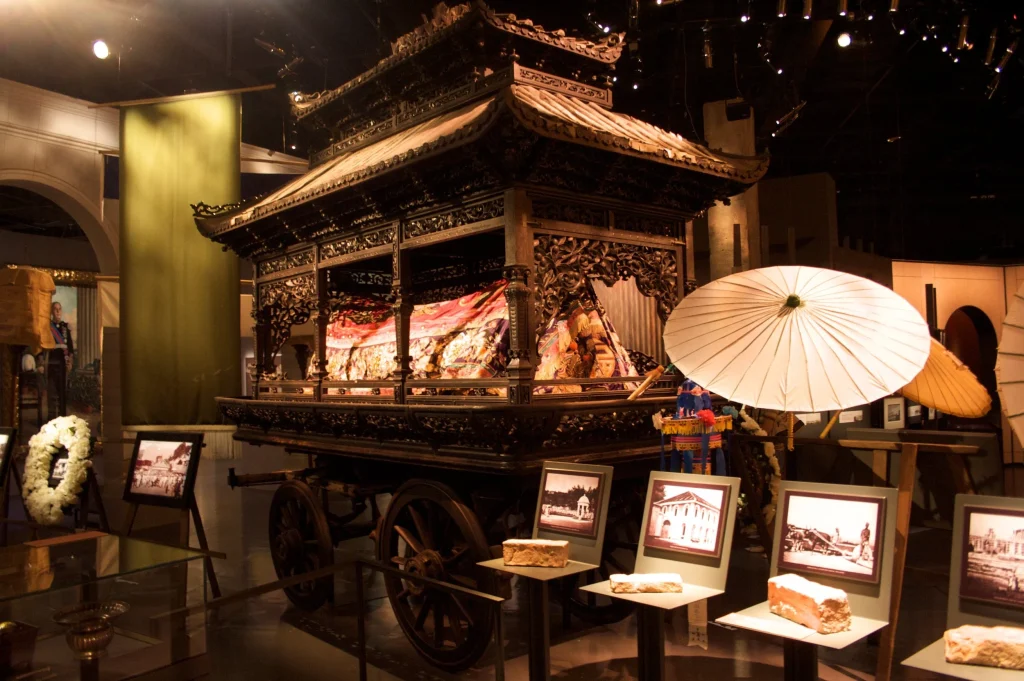
Maps, photographs and prints reveal how dramatically the island changed, while everyday objects and personal stories bring another dimension to the period. Singapore emerges as a cosmopolitan city, but also one marked by significant inequality.
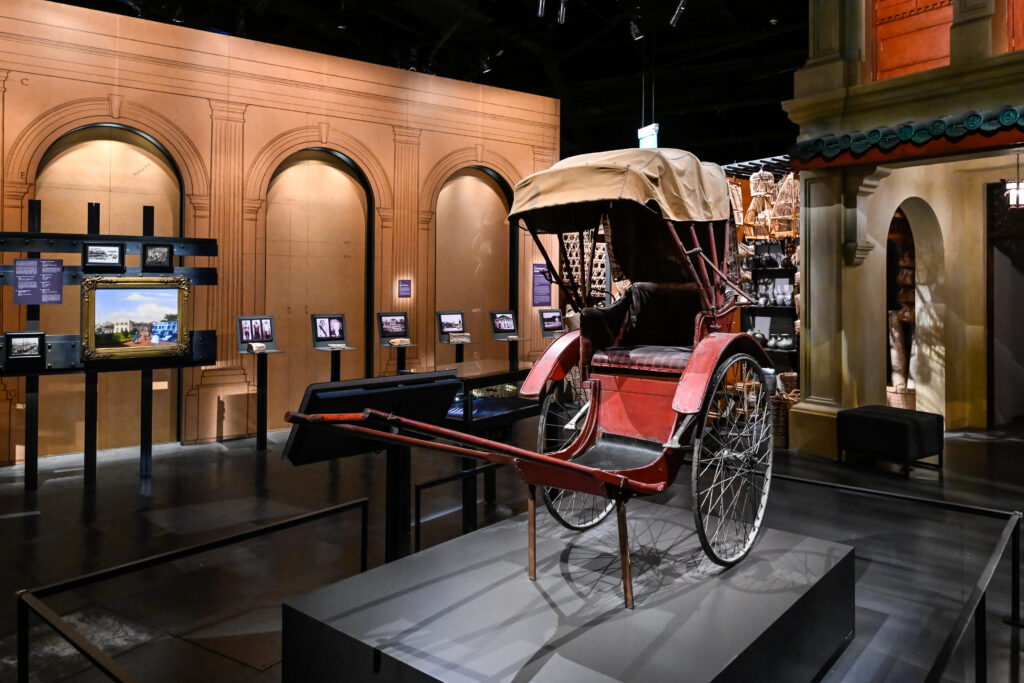
History becomes physical through a phygital interactive that allows visitors to try lifting and pulling a recreated rickshaw. The experience then moves towards the political awakening of the period, as nationalism spread across the region and Singapore’s diverse communities began imagining a future beyond imperial rule.
Fall of the Fortress: War, Occupation and Resilience
The mood changes dramatically as the story reaches the late 1930s and 1940s.
Fall of the Fortress explores the disruption of Singapore’s social fabric during the Japanese occupation, while also highlighting the resilience that emerged from those difficult years. Propaganda posters and wartime photographs illustrate how the Sino-Japanese War created tensions that reached into Singapore’s communities.
An interactive presentation of a painting by Force 136 veteran Tan Chong Tee, displayed alongside the original, follows key events of the Sino-Japanese War between 1937 and 1939 and the mounting pressures that eventually brought conflict to Singapore.
The collapse of Britain’s “impregnable fortress” is explored through military artefacts, personal effects and letters that bring the human consequences of the campaign into sharp focus. Visitors can even step into the moment of surrender through an interactive Morse code station before following the aftermath of occupation and the beginnings of a Malayan identity.
Towards a New Identity: The Road to Self-Governance
The 1950s and 1960s were years of enormous change, and Towards a New Identity captures the energy, uncertainty and ambition of the period.
Post-war Singapore faced poverty and widespread dissatisfaction with colonial rule. At the same time, artists and activists found new ways to express hopes for change through woodblock prints, literature and theatre. Student demonstrations and labour strikes brought those aspirations into the streets, while emerging local leaders debated competing visions for Singapore’s future.
Music also provides a powerful connection to this era. Zubir Said’s piano, displayed in the Gallery for the first time, anchors the period’s civic and cultural story. It was the instrument on which he composed “Majulah Singapura”.
The section culminates in a multimedia recreation of Lee Kuan Yew’s televised press conference announcing Singapore’s separation from Malaysia—a pivotal moment that visitors are invited not simply to watch, but to pause and contemplate.
Becoming Singapore: Building a Modern Nation
The journey continues into the 1960s through the 1980s, when Singaporeans were building new lives while the country underwent major reforms in its economy, housing and education.
Industrialisation transformed the employment landscape. Everyday artefacts from Fairchild Semiconductor capture the experiences of a generation of workers, many of them women, who found new opportunities in factories that helped reshape Singapore’s economy.
The transformation of everyday life is equally important. A restored HDB lift evokes the move from kampongs into high-rise homes, accompanied by a poem reflecting the mixture of excitement and anxiety that came with such profound social change.
As incomes rose and modern conveniences became increasingly common, a new generation grew up under a revised bilingual education system. A shared Singaporean identity gradually took shape.
Visitors can sit in a recreation of a typical void deck and read Arthur Yap’s poem “2 mothers in a h d b playground”—an intimate glimpse of ordinary life in a country finding its footing.
Food, Fashion, Film and the City
Another side of Becoming Singapore is vibrant, colourful and unmistakably modern.
Inspired by Orchard Road, a passageway of street lamps and signboards leads visitors into a world of food, fashion, film, sports and nightlife. It is a celebration of how Singaporeans increasingly expressed their identities through lifestyle and leisure.
Food culture takes centre stage through a phygital Hawker Table. Visitors can tap and rotate food items to unlock stories about Singapore’s famous hawker culture.
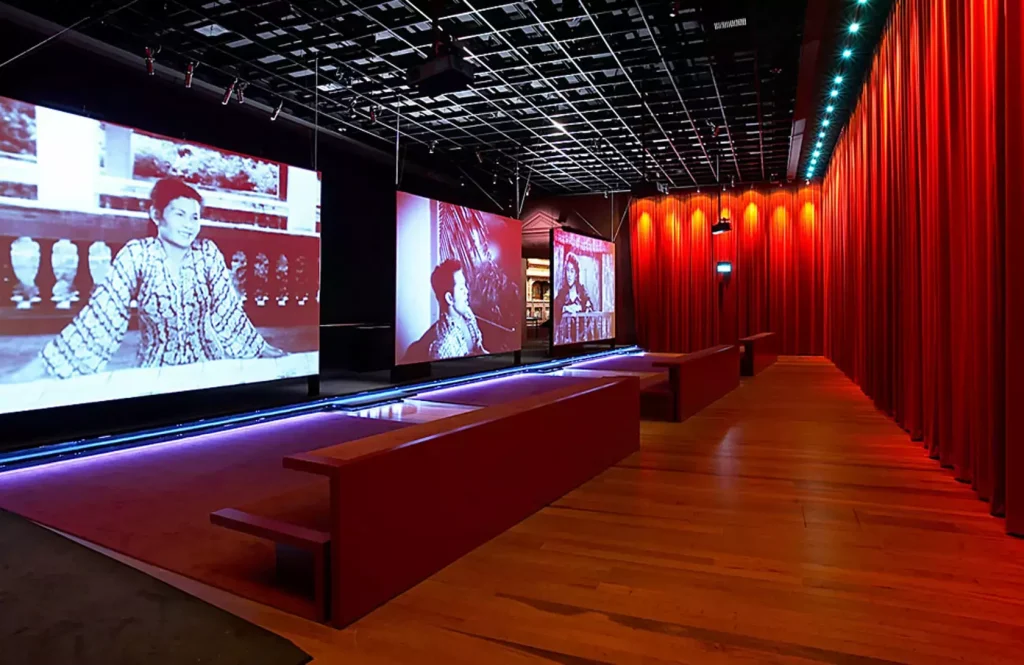
The section also explores the emergence of independent filmmakers who brought Singlish to the screen and homegrown designers who began making an impact internationally. Sport provided another source of shared national pride, with archival footage of the Great Singapore Workout inviting visitors to engage with a memorable moment from the era.
As the millennium approaches, the Gallery captures a city preparing for another transformation—and a population ready to embrace it.
Looking Global: Singapore in the 21st Century
The final historical zone brings the story into the 2000s and the present day.
Looking Global explores Singapore’s emergence as a major financial and maritime hub and a world-class metropolis. Yet the emphasis remains firmly on people: diverse, dynamic communities living in a city that is constantly reinventing itself.
Photographer Keith Loutit’s The Lion City 2012–2026 compresses almost 15 years of development and redevelopment into two and a half minutes, offering a striking visual portrait of a rapidly changing city.
An interactive mural then places Singapore within global networks of trade, travel and communication. Visitors discover stories of technological innovation, sustainability and humanitarian efforts, while being encouraged to consider a deeply personal question: what does it mean to belong to a city that never stands still?
The section closes with Who Are We Today?, a film featuring candid conversations with residents from diverse backgrounds. Its central question is also directed towards the visitor, making the Gallery’s final chapter deeply personal.
A Future Written by Its Visitors
The journey does not simply end when the historical timeline reaches today. Instead, the Gallery looks forward.
In a cinematic concluding experience, Singapore’s past and present flow into an immersive visual landscape. A projected river carries glimmers of voices contributed by visitors throughout the Gallery. Their values, beliefs and aspirations come together to create a unique vision of Singapore’s future, accompanied by a reflection assembled from their own words.
It is a fitting conclusion to a museum experience built around the idea that history belongs to everyone.
The Singapore History Gallery is therefore more than a chronological account of events. It is a story of movement, migration, conflict, resilience, creativity, transformation and belonging. It shows how the great forces of history are experienced through ordinary lives—and how a nation’s identity is continually shaped by the people who call it home.
Celebrating 139 Years of the National Museum
The reopening forms the centrepiece of the National Museum of Singapore’s 139th Anniversary Celebrations, Stories of Everyday, running from 10 to 18 October 2026.
The celebrations extend the Gallery’s spirit of shared conversation into the wider Museum. Highlights include The Living Archive: A Living & Design Market by Of Wonder Wander, featuring ceramics, stationery, accessories, food and more, as well as a refreshed vendor line-up on 14 October.
The National Living Room installation recreates a living room from the past using objects and stories contributed by Singaporeans, exploring the difference between a house and a home.
Visitors can also meet Stoney, the Museum’s new mascot inspired by the Singapore Stone. Stoney’s story begins on the banks of the Singapore River, where he awakens without knowing where he came from. His islandwide journey through modern Singapore ultimately leads him home to the National Museum, coinciding with the reopening of the Gallery.
Meet-and-greets, photo opportunities and a larger-than-life Stoney installation add a playful dimension to the celebrations. A Stoney keychain plush will also be available from 10 October.
The anniversary programme includes contemporary dance by T.H.E Dance Company, heritage talks, roving historical figure performances and community music jamming with Ann Siang Sounds.
A Museum for a Living Singapore
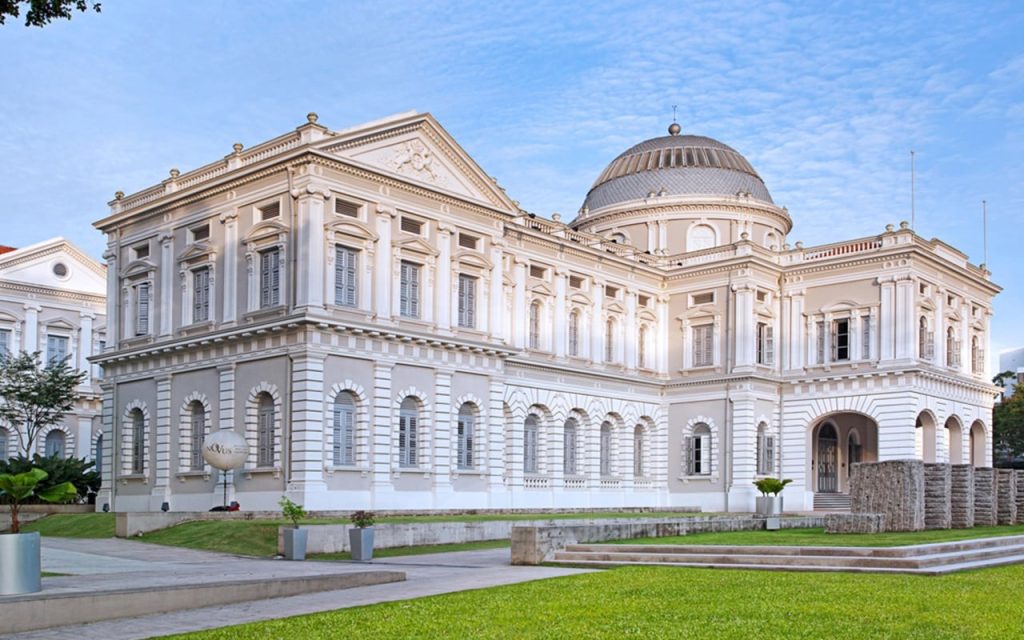
With a history dating back to 1887, the National Museum of Singapore is the nation’s oldest museum, yet its approach to history continues to evolve. Its galleries use multiple perspectives, important artefacts and innovative presentation techniques to explore Singapore and the wider world.
The reopening of the Singapore History Gallery marks an important milestone in that continuing evolution. It offers a chance to look backwards, but also to ask what comes next.
Whether you are discovering Singapore for the first time, returning to a place you know well, or simply curious about how a small island became the dynamic global city it is today, the Gallery promises a journey filled with stories, objects, voices and moments of discovery.
Most importantly, it leaves visitors with a question rather than a conclusion: where do you see yourself in Singapore’s story?
That may be the most exciting part of the experience. Because the story is not finished. Singapore continues to change, its people continue to shape it, and every new generation adds another chapter.